
You can use most open source URL shorteners commercially, but the license decides what you owe in return. Permissive licenses like MIT and Apache 2.0 ask mainly for attribution. The AGPL requires you to offer your source code to users if you modify the software and let people use it over a network. Read the LICENSE file first, then check the dependencies, because the shortener's license is only one of several you inherit.
TL;DR:
- Any license approved by the Open Source Initiative allows commercial use. If a license restricts business use, the software is source-available, not open source.
- The AGPL needs the closest reading, because modifying the code and running it for users over a network triggers a duty to share your changes.
- For client work, three situations matter: hosting the shortener for them, handing the install over to them, and modifying the code. Each carries different obligations.
- Check the LICENSE file, the package manifest, file headers and the dependency list. A mismatch between them is a red flag.
- Open-core projects can put features, themes or data files under separate terms, so confirm the feature you need is covered by the open license.
Table of Contents
- Open Source URL Shortener License and Commercial Use: What the Label Guarantees
- Where to Find the License, and Which File Wins
- Six License Types You Will Actually See on a Shortener
- When the AGPL Applies to Client Work, and When It Does Not
- Hidden Restrictions: Dependencies, Open-Core Features and Trademarks
- A Ten-Minute Audit You Can Run Before You Install
- Get a Self-Hosted Shortener With Terms You Can Read in One Sitting
- Frequently Asked Questions
- Sources
Open Source URL Shortener License and Commercial Use: What the Label Guarantees
The phrase "open source" guarantees more than most people expect. The Open Source Initiative's Open Source Definition says an approved license may not restrict anyone from using the program in a specific field of endeavor, and it names business use as an example. Clause 1 adds that the license cannot stop you from selling the software as part of a larger distribution. So if a shortener carries an OSI-approved license, commercial use is allowed.
The label does not settle the price of that permission. Some licenses want a copyright notice kept. Others want your modifications published. That is where agencies and businesses get caught, and this article covers it.
If you are still deciding whether to self-host an open source shortener at all, the main comparison of open source link shorteners covers the operational trade-offs. Here we assume you have a candidate and want to know if you can legally run it for money.
Clause 6 of the Open Source Definition bars any OSI-approved license from restricting use in a business. If a project says "free for non-commercial use only," it is not open source.
Where to Find the License, and Which File Wins
Start in the repository root. Look for a file named LICENSE, LICENSE.md, COPYING or LICENSE.txt. Then cross-check it in four more places, because projects drift.
- The package manifest. A
composer.jsonorpackage.jsonhas alicensefield. It should use an identifier from the SPDX License List, such asMIT,Apache-2.0orAGPL-3.0-only. - File headers. Source files often carry a comment naming the license. If the headers say one thing and the root file says another, the project has a problem, and so do you.
- The README and docs. These are the weakest evidence. A README that says "free to use" without a license file grants you nothing in writing.
- The release you downloaded. Licenses can change between versions. The license on the current main branch does not automatically apply to the older tag you installed, and vice versa.
If there is no license file at all, the default is all rights reserved. Code in a public repository without a license is visible, but you have no permission to run it commercially. Ask the maintainer to add one, or pick a different project.
The SPDX suffix matters more than it looks. GPL-3.0-only locks you to version 3. GPL-3.0-or-later lets you choose a later version. They are different grants.
Six License Types You Will Actually See on a Shortener
Most self-hostable shorteners fall into one of the families below. The table is a screening tool, not legal advice.
| License | Commercial use | Client work | The catch |
|---|---|---|---|
| MIT | Yes | Yes | Keep the copyright and permission notice in copies |
| BSD (2- and 3-clause) | Yes | Yes | Keep notices; the 3-clause version bars using the authors' names to endorse your product |
| Apache 2.0 | Yes | Yes | Keep the NOTICE file, state your changes, and note it grants no trademark rights |
| GPL 3.0 | Yes | Yes | If you distribute it, including to a client, you must pass on the license and source |
| AGPL 3.0 | Yes | Yes, with care | Modified versions offered over a network must come with source for those users |
| Source-available (BSL, Commons Clause, custom terms) | Often restricted | Often restricted | Not open source; read the exact grant and the competing-use clause |
Permissive licenses: MIT, BSD and Apache 2.0
These are the easy ones. You can modify the code, bundle it into a client project and keep your changes private. The Apache License 2.0 text adds an express patent grant, which MIT lacks, and states in section 6 that it does not give you permission to use the licensor's trademarks. For client work with the least friction, we would pick one of these every time.
Copyleft: GPL and AGPL
Copyleft licenses allow commercial use and require that derivative works carry the same terms. The GPL's duties trigger when you distribute the software. Run a modified GPL shortener on your own server for your own links and you owe nobody your source. The AGPL closes that gap, as the next section explains.
Source-available licenses
The Business Source License, the Commons Clause and bespoke "fair code" terms let you read the code, but they usually restrict commercial or competing use. A common pattern bans offering the software as a hosted service to third parties, which is what an agency running shorteners for clients may be doing. Treat these as proprietary licenses with visible source, and read every line of the grant.
When the AGPL Applies to Client Work, and When It Does Not
The GNU Affero General Public License v3 exists because ordinary copyleft did not cover software that people use through a server without ever receiving a copy. Section 13 fills that gap.
AGPL section 13: if you modify the program, you must offer the corresponding source to every user who interacts with it remotely over a network.
Three situations come up for client work.
You host an unmodified install for a client
Running the stock code triggers no source-sharing duty under section 13, since that clause applies to modified versions. Keep the license text and copyright notices intact, including any in the admin interface.
You hand the install over to the client
Giving a client a copy is distribution. Under the GPL and AGPL you must pass along the license and make the source available to them. For an interpreted language like PHP, that is simply the files you delivered. Put the LICENSE file in the handover package and say so in your contract.
You modify the code
Custom branding, new routes and a changed analytics module each count as a modification. Under the AGPL, the people who log into the dashboard are users interacting over a network, so you owe them the modified source. A visitor who clicks a short link arguably interacts with the program too, and the conservative reading is to assume that includes them. The practical fix is to publish your fork, or keep changes in a separate service that talks to the shortener only through its public API.
Pro Tip: Some AGPL projects sell a separate commercial license that removes the network-source obligation. Ask the maintainer before you fork. A one-time commercial grant can cost less than a lawyer's afternoon, and it gets you a signed document you can show a client's procurement team.
Hidden Restrictions: Dependencies, Open-Core Features and Trademarks

A clean top-level license does not mean the whole install is clean. Look for these.
- Dependency licenses. A shortener is built on libraries. Run your language's license checker (for PHP or Node projects, the package manager can list licenses) and look for anything outside your comfort zone. Mixing licenses has compatibility rules. Apache 2.0 code, for example, is compatible with GPLv3 but not with GPLv2-only.
- Open-core splits. Some projects publish a free core and sell a paid edition. Features such as SSO, team roles, A/B testing or advanced analytics may sit under a proprietary license even if the repository looks open. Search the repository for files with different headers.
- Data files. Geolocation databases, flag icons and fonts usually carry their own terms. Click maps need location data, and that data is often licensed separately from the code that reads it.
- Trademarks. Open licenses cover code, not names or logos. You can run the software, but you may not present your service under the project's name or imply it endorses you.
- Contributor agreements. A CLA lets the maintainer relicense contributions later. That can be fine, and it explains why a project's license sometimes changes between versions.
Output is a separate matter. Links you create and QR codes you generate belong to you, not to the software's authors. If you produce print QR codes for clients, the file formats and sizing rules in QR Code SVG vs PNG for Print matter more than the license does.
A Ten-Minute Audit You Can Run Before You Install
Do this before the software touches a client's domain.
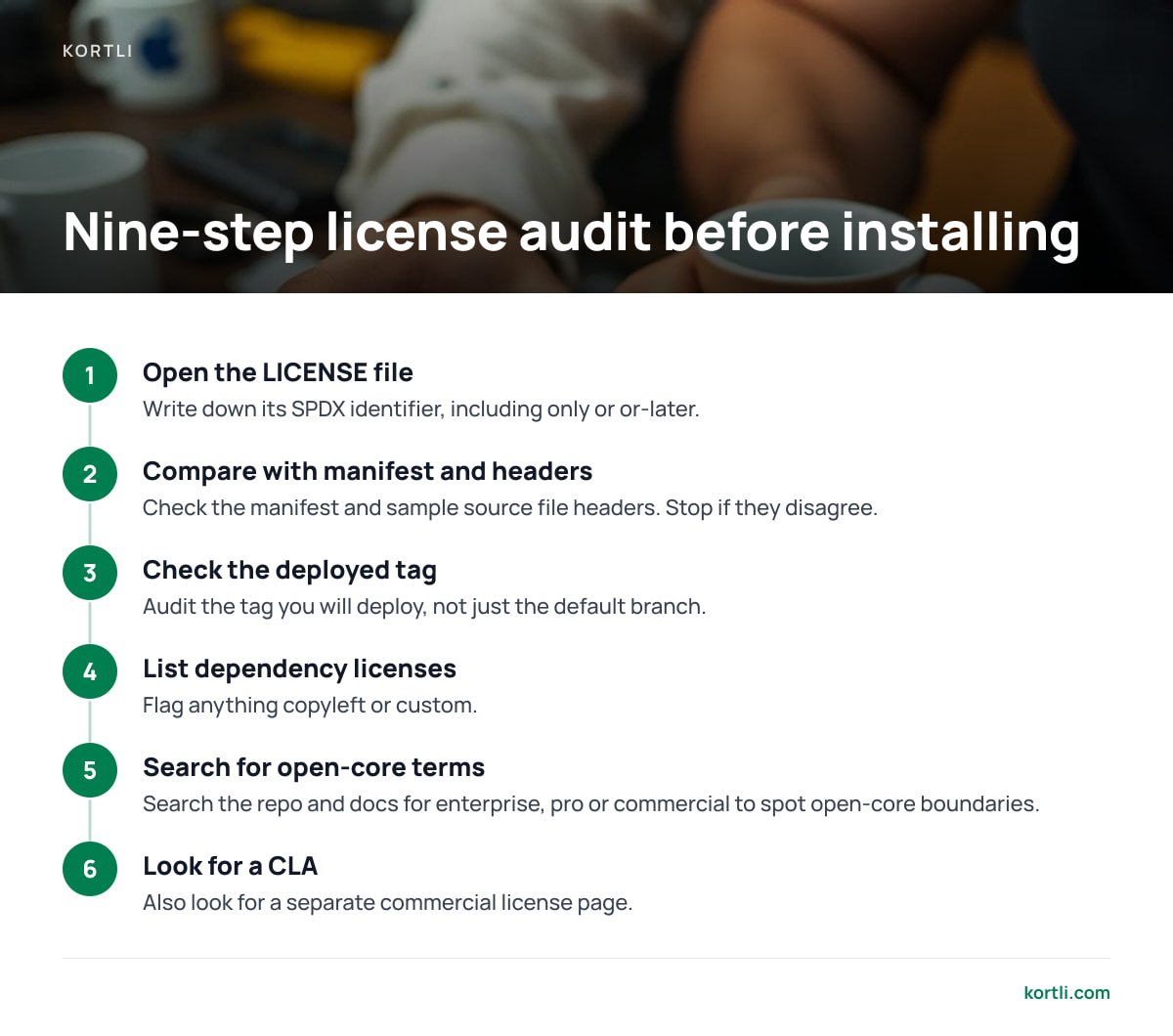
- Open the LICENSE file and write down its SPDX identifier, including
onlyoror-later. - Compare it with the manifest and a sample of source file headers. Stop if they disagree.
- Check the tag you will deploy, not just the default branch.
- List dependency licenses and flag anything copyleft or custom.
- Search for "enterprise," "pro" or "commercial" in the repo and docs to spot open-core boundaries.
- Look for a CLA or a separate commercial license page.
- Decide your modification plan. If you will change code under the AGPL, decide now whether you will publish it.
- Save a copy of the license text and the commit hash you audited. If terms change later, you can show what applied when you installed.
- Put it in the contract. For client deployments, say which license governs the software and who holds the source obligations.
If the project fails step 1, stop. If it fails any other step, ask the maintainer or a lawyer before you proceed. A license audit costs minutes. A forced rewrite after a client launch costs weeks.
Get a Self-Hosted Shortener With Terms You Can Read in One Sitting
Open source shorteners put licensing work on you: dependencies, AGPL scope, open-core boundaries. If you would rather skip it, Kortli is commercial software with a one-time license instead of a subscription. You install it on your own Linux server, add as many branded domains as you want with no per-domain fee, and keep click data and geographic tracking on that server. Password-protected links, A/B split testing and logo-embedded QR codes are included. If you use password links, read how to stop Google indexing a password protected page before you publish them.
Kortli is proprietary, so you cannot fork or redistribute it, and you maintain the server yourself. Read the license terms on the site before you buy, as you would for any product. Check the current price on the pricing page too, since we would rather you see the live number than trust one printed here.
Frequently Asked Questions
Can I use an open source URL shortener for my business?
Yes, if the license is approved by the Open Source Initiative, because its definition prohibits restrictions on business use. You still have to meet the license's conditions, such as keeping copyright notices or sharing modified source under the AGPL.
Can I run an AGPL shortener for a client without publishing my code?
If you run it unmodified, section 13 of the AGPL does not require you to publish anything, though you must keep the license notices. If you modify it and users interact with it over a network, you must offer them the modified source. Keeping custom features in a separate service that calls the shortener's API is a common way to avoid that.
Is "free for non-commercial use" open source?
No. The Open Source Definition forbids discrimination against fields of endeavor, and commercial use is one of them. A license with a non-commercial clause is source-available, and you need separate permission to use it for business or client work.
Where do I find the license of a shortener on GitHub?
Look for a LICENSE or COPYING file in the repository root, then confirm it against the license field in the package manifest and the headers in source files. GitHub often shows the detected license in the repository sidebar, but that detection can miss custom terms.
Do I need a lawyer to check an open source license?
For MIT, BSD or Apache 2.0 used unmodified, the terms are short enough to read yourself. For AGPL modifications, source-available licenses, or anything you will resell to clients, a short legal review is worth the cost. This article is general information, not legal advice.
Sources
- The Open Source Definition | Open Source Initiative
- GNU Affero General Public License, Version 3 | Free Software Foundation
- SPDX License List | Linux Foundation, SPDX Project
- Apache License, Version 2.0 | Apache Software Foundation
- Frequently Asked Questions about the GNU Licenses | Free Software Foundation
Leave a Reply