
Over 5 years means 60 monthly payments, and that single number changes how a loan, a percentage, or a subscription actually behaves. A $20,000 loan over 5 years at a typical rate runs around $396 a month and ends on schedule; a $29-a-month subscription over the same stretch costs less per month but never stops, and by month 61 you're still paying for something a one-time purchase would have already finished paying off.
TL;DR:
- "Over 5 years" is 60 months, 260 weeks, or roughly 130 biweekly pay periods — match your calculator to how often you actually pay.
- A $20,000 loan over 5 years at 7% APR runs about $396 a month and $23,760 total, which is roughly $3,760 in interest on top of the $20,000.
- Percentage change over 5 years has two honest answers — total change and CAGR (annualized rate) — and they are never the same number.
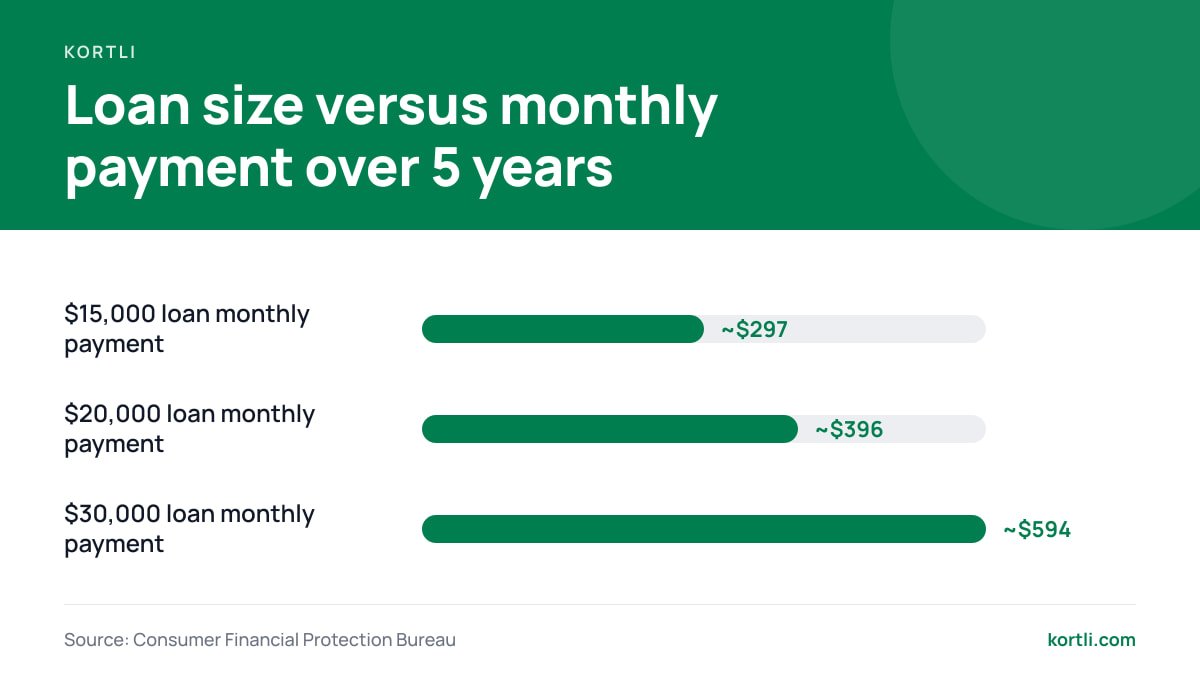
- A $30,000 loan over 5 years costs about twice the monthly payment of a $15,000 loan at the same rate, because the relationship is linear, not front-loaded.
- Unlike a loan, a monthly subscription over 5 years never amortizes to zero; a $29-a-month plan totals $1,740 and leaves you owning nothing at the end.
Table of Contents
- How Many Months Are "Over 5 Years"? The Number Every Calculator Needs First
- What a $20,000 Loan Over 5 Years Actually Costs You Each Month
- Car Loan or Mortgage? Why "Over 5 Years" Means Two Different Things
- How to Calculate Percentage Change Over 5 Years (Two Honest Answers, Not One)
- The Subscription Math Nobody Runs: What "Over 5 Years" Costs When the Bill Never Ends
How Many Months Are "Over 5 Years"? The Number Every Calculator Needs First
Five years is 60 months. That's the figure every loan calculator, amortization schedule, and payment plan is built around, and it's worth writing down before you touch a single formula, because getting it wrong throws off everything downstream. If you're paid weekly, 5 years is 260 pay periods. If you're on a biweekly schedule, it's about 130. Mixing these up — plugging 60 into a calculator that expects weekly periods — is the single most common reason people get a wildly wrong payment estimate online.
Payments per 5 years also depend on the schedule you choose, not just the term. A standard loan set up with monthly payments gives you 60 payments over 5 years. Switch to biweekly payments on the same loan and you get 130 payments instead — and because 130 biweekly payments equal 13 monthly payments' worth of money instead of 12, you end up paying the loan off slightly faster without renegotiating anything.
Pro Tip: If your lender allows biweekly payments on a 5-year loan, take it. You're making 13 monthly-equivalent payments a year instead of 12, which typically shaves three to four months off a 60-month term at no change to your interest rate — it's the closest thing to a free prepayment most loans offer.
What a $20,000 Loan Over 5 Years Actually Costs You Each Month
The math behind a loan payment isn't guesswork — it's a fixed formula (the standard amortization formula) that takes the loan amount, the monthly interest rate, and the number of payments, and spits out a payment that stays flat for the entire term while the mix of interest and principal inside it shifts every month. At an illustrative 7% APR, a common rate range for a good-credit auto loan, a $20,000 loan over 5 years runs about $396 a month. Over 60 payments, that's $23,760 total, meaning you pay roughly $3,760 in interest on top of the $20,000 you borrowed.
A $20,000 loan at 7% APR over 5 years costs about $3,760 in interest — money a one-time purchase never charges you.
The Consumer Financial Protection Bureau describes amortization as the process by which each payment on a loan is split between interest and principal, with the interest portion shrinking and the principal portion growing every month until the balance hits zero on schedule. That's the mechanism behind every number in this article — nothing about it is specific to one lender or one calculator.
$15,000, $20,000, and $30,000 Over 5 Years, Side by Side
Here's the same 7% APR, 60-month math applied to the three loan amounts people search for most, so you can see how the numbers scale:
| Loan Amount | APR | Monthly Payment | Total Paid (60 mo.) | Total Interest |
|---|---|---|---|---|
| $15,000 | 7% | ~$297 | ~$17,820 | ~$2,820 |
| $20,000 | 7% | ~$396 | ~$23,760 | ~$3,760 |
| $30,000 | 7% | ~$594 | ~$35,640 | ~$5,640 |
Notice the relationship is linear: double the loan amount and the monthly payment roughly doubles too, because the rate and the term are identical across all three rows. What changes the payment meaningfully isn't the loan amount alone — it's the rate you're offered and the term you choose. A lower rate or a shorter term both reduce total interest; a longer term lowers the monthly payment but increases what you pay overall.
Car Loan or Mortgage? Why "Over 5 Years" Means Two Different Things
A 5-year, 60-month term used to be the standard length for a car loan, and it's still the baseline every finance calculator defaults to. But Experian's State of the Automotive Finance Market has tracked average new-car loan terms drifting well past 60 months in recent years, which means a strict 5-year loan is now the shorter-than-average option, not the norm — a useful thing to know if a dealer presents a 72-month term as standard.
A mortgage is a different animal. Full mortgage amortization almost never runs just 5 years; it typically spans 15 to 30 years. Where "5 years" shows up in mortgage language is the fixed-rate term — in Canada, for instance, a 5-year fixed rate within a 25-year amortization is the structure Canada Mortgage and Housing Corporation describes as the market default, meaning your rate is locked for 5 years even though the loan itself takes decades to pay off. Confusing a 5-year mortgage term with a 5-year mortgage amortization is the single most common mix-up in this category of search.
How to Calculate Percentage Change Over 5 Years (Two Honest Answers, Not One)
There isn't one percentage-over-5-years calculation — there are two, and they answer different questions. Total change over 5 years is simple: (ending value − starting value) ÷ starting value, expressed as a percentage. If something goes from $100 to $150 over 5 years, that's a 50% total increase. Full stop.
But 50% over 5 years isn't the same as 50% happening evenly, and it definitely isn't the annual growth rate. That's what CAGR — compound annual growth rate — measures instead: (ending value ÷ starting value) raised to the power of (1 ÷ number of years), minus 1. The U.S. Securities and Exchange Commission's Investor.gov describes CAGR as the standard way to express an investment's smoothed, year-over-year growth rate even when actual annual returns bounced around.
A value that grows 50% over 5 years is only compounding at roughly 8.45% a year — total change and annualized rate are never the same number.
Run the $100-to-$150 example through the CAGR formula and you get about 8.45% a year, not 10% (which is what you'd get by lazily dividing 50% by 5). That 1.5-point gap is exactly the kind of error that makes a five-year pitch deck look better than it is.
The Subscription Math Nobody Runs: What "Over 5 Years" Costs When the Bill Never Ends
A loan is designed to end. A subscription isn't, and that difference matters more over a 5-year horizon than most people account for. Hosted link-shortener plans — Bitly included — typically price their tiers somewhere between roughly $8 a month at the entry level and several hundred dollars a month for advanced plans with custom domains and deeper analytics. Multiply any of those by 60 months and the number stops looking small.
| Monthly Cost | 5-Year Total | What You Own at Month 60 |
|---|---|---|
| $8/mo | $480 | Nothing — cancel and links can stop redirecting |
| $29/mo | $1,740 | Nothing — same |
| $99/mo | $5,940 | Nothing — same |
That last column is the part a loan calculator never has to show you, because a loan transfers ownership to you at the end. A subscription doesn't — cancel a hosted shortener after 5 years of payments and the links you built your marketing around can break the same day. If you want the fuller trade-off between hosted and self-managed link infrastructure, Open Source Link Shortener: The Real Trade-Offs, Compared lays out where each approach act
Leave a Reply